
KDArchitects Landscape Ideas by Morph: Sustainable Outdoor Design for 2026

Years of working on residential and commercial architecture taught me one thing clearly: a home does not end at the front door. The land it sits on is part of the design. That is the exact belief driving KDArchitects landscape ideas by Morph. Roger Morph, lead designer at Homedomio, treats every yard as an architectural extension of the house, not a patch of grass left as an afterthought.
In 2026, the American Society of Landscape Architects (ASLA) reports that 72% of homeowners say outdoor living space is now a priority purchase driver. Morph’s approach lines up exactly with where design is heading native plants, minimal upkeep, indoor-outdoor connection, and region-specific materials that age well.
Why Landscape Design Matters for Every Home in 2026
Good landscape design is not decoration. It is functional planning that affects how you live daily. According to a 2026 National Association of Realtors survey, well-executed landscaping increases resale value by 15 to 20 percent. Buyers form their first impression from the yard before they walk through the door. Beyond money, greenery reduces stress, filters air, muffles noise, and lowers indoor temperatures in summer. Outdoor spaces matter as much as any room inside the house.
Who Is Roger Morph and the KDArchitects Design Philosophy
Roger Morph is KDArchitects’ lead landscape designer. His central idea is simple: blending architecture with nature so the house and its land read as one composition. He calls this the “organic extension” ; the yard grows outward from the building, sharing its materials, lines, and character. A brick wall from the interior continues as a garden border. A glass door aligns with a stone patio. The roofline frames a row of trees. Nothing is dropped randomly on the land.
The Organic Extension: Connecting Indoor and Outdoor Space

Continuous rooms are Morph’s signature move. He uses the same floor material inside and outside kitchen slate tiles carried out through the glass door onto the patio. The brain reads this as one unbroken space, making the home feel larger without adding square footage. Large glass windows act as living picture frames, with a Japanese Maple or flowering tree planted to sit perfectly in view. The inside and outside connect visually at every angle.
Planning the Outdoor Layout: Zones, Flow, and Function
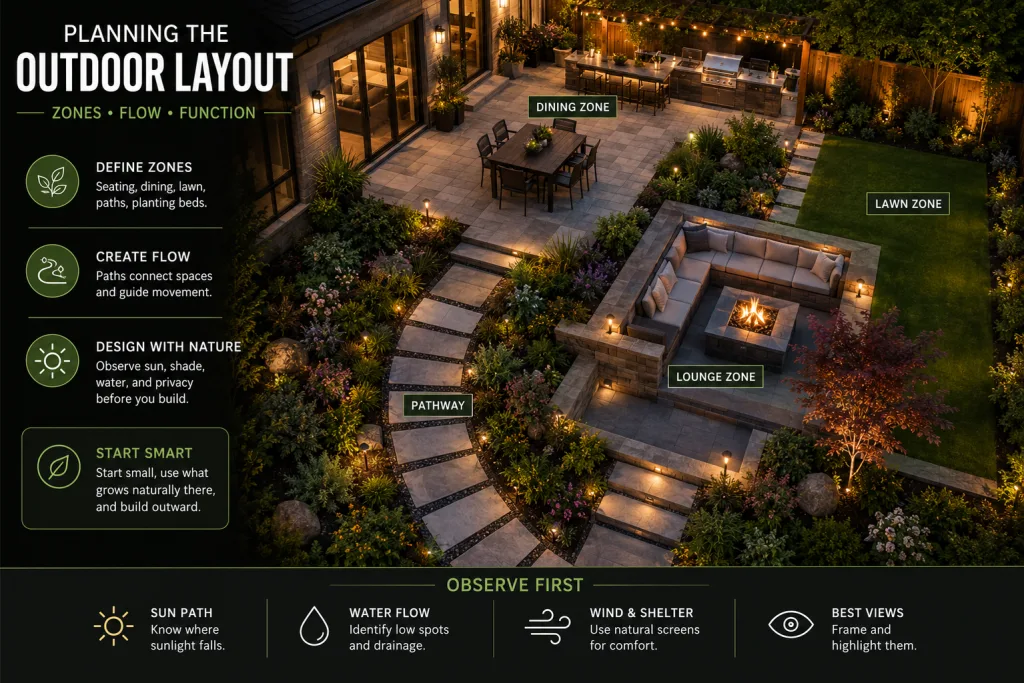
Before selecting any plant or material, assess the yard first. KDArchitects breaks every project into clear zones: softscaping, hardscaping, and decorative accessories. Defining zones, seating, paths, planting beds, lawn before anything is built makes the design clean and the budget easier to manage. Morph always says: start small, use what grows naturally there, and build outward. Walking the property at different times of day reveals where sun falls, where water pools, and which spots feel sheltered. Design follows that observation.
Softscaping: Native Plants, Low Maintenance, and Real Beauty

Softscaping covers every living element lawns, trees, shrubs, flower beds, and ground cover. Morph’s rule is always the same: native plants first. They evolved with local soil and climate, need less water, attract pollinators, and outlast imported ornamentals. In 2026, with drought conditions expanding across the South and West, this is not just good design, it is practical necessity. Low maintenance landscapes with native species cost less to run year over year.
Region-Specific Plant Selection
- Arizona / Southwest — xeriscaping plants such as agave, sagebrush, succulents, and desert grasses. Minimal irrigation. Gravel ground cover replaces thirsty lawn.
- Seattle / Pacific Northwest — tall firs, ferns, and moisture-tolerant ground cover that match the surrounding green landscape naturally.
- South — live oaks, magnolias, and coneflowers. Heat-tolerant, shade-giving, and suited for year-round outdoor use.
- Midwest / Chicago — native grasses, wildflowers, and rain gardens that manage seasonal flooding and support local ecosystems.
- Texas / West — drought-tolerant plants, gravel paths, and low-water planting schemes built for intense summer heat.
- New York / Northeast — structured perennial borders, cold-hardy shrubs, and compact designs that maximize smaller urban yards.
Mass Planting Over Chaotic Variety
Morph avoids the common mistake of planting one of everything. Instead, he uses mass planting thirty of the same native grass in a row, or a wide sweep of coneflowers along a border. Repetition reads as intentional and bold. It keeps the yard from visually competing with the house. Three color tones deep green, silver, and warm wood form the base palette in most KDArchitects designs.
Hardscaping: Paths, Patios, Walls, and Structural Materials

Hardscaping covers patios, walkways, outdoor kitchens, retaining walls, and fencing the structural bones of the yard. KDArchitects choose materials that match the home’s exterior and age well locally: quarried stone, recycled timber, and permeable pavers. In 2026, permeable surfaces are increasingly required in areas with stormwater regulations across Chicago, Seattle, and New York. Every hardscape element should serve a dual purpose: not just look good, but actively do something.
Pathways — Style and Direction
A well-placed path creates movement and character. Use stone, concrete slabs, or gravel straight for a modern look, curved for a natural feel. Adding lights along the pathway extends usability into evening hours and improves safety. Loose gravel paths also absorb rainwater and feed tree roots below, solving drainage and design at once.
Patios as Outdoor Rooms
A patio becomes an outdoor room when it has defined edges, comfortable furniture, shade overhead, and lighting. Morph places fire pits, outdoor kitchens, and integrated stone seating to make patios function year-round. A stone wall built at exactly 18 inches high doubles as permanent seating with no cheap plastic chairs needed. Sunken fire pit areas block wind naturally and create a sheltered gathering space.
Retaining Walls and Terracing
Steep lots are not wasted space. KDArchitects cut terraced steps into hillsides, each level with a flat floor for dining, planting, or relaxing. This turns a drainage problem into a multi-level outdoor living space. Smart slope stabilization prevents erosion while adding usable square footage at far lower cost than interior additions.
Xeriscaping and Rain Gardens: Smart Water Solutions for 2026
The EPA WaterSense program estimates outdoor water use accounts for nearly 30 percent of household consumption. Morph addresses this directly. Xeriscaping plants survive Arizona summers without irrigation agave, sagebrush, and succulents store water internally. In wetter regions, rain gardens collect runoff in shallow planted dips rather than letting it flood streets. Both approaches cut water bills and maintenance costs significantly in 2026 conditions.
Outdoor Lighting: Extending the Yard Into the Evening

Lighting is a design element in KDArchitects projects not just a utility. Warm, low-level pathway lights, spotlights on feature trees, and wall-mounted fixtures around the patio extend how long outdoor spaces are actually used. In 2026, solar-powered LED landscape lighting will become affordable enough for most residential projects. Soft warm tones create a calm atmosphere; cool white is avoided in outdoor residential settings because it feels clinical, not welcoming.
Water Features: Calm, Elegance, and Practical Benefits

A small water feature, a wall fountain, a shallow reflection pond, or a simple stone basin adds sound, movement, and visual calm to a yard. Morph uses water features as focal points in minimalist designs where a single strong element anchors the space. Morphing water features also support local wildlife, giving birds and pollinators a reliable water source. In hot regions like Texas or Arizona, moving water lowers the surrounding air temperature slightly through evaporative cooling.
Vertical Gardens and Small Space Landscaping

Urban homes in New York, Chicago, or Seattle often have minimal ground space. Morph’s answer is vertical living walls panels of native plants or trailing species mounted on fences or exterior walls. They insulate the building, reduce urban heat, and bring greenery into tight spaces. Terraced balcony gardens and rooftop planters follow the same logic: if the yard cannot go wide, it goes up. Even a small balcony with structured planters, one shade tree in a large container, and warm lighting becomes a usable outdoor room.
Decorative Accessories: Small Touches That Complete the Yard
After structure and plants are in place, decorative elements give a yard its character. Morph’s philosophy here is a minimal design approach with one focal point only. A single specimen tree, a small pond, or a stone bench surrounded by open space. Outdoor rugs, weather-resistant cushions, lanterns, and pergola lighting complete the outdoor room without cluttering it. Scale matters: test furniture size against the yard before buying. Large sofas in a small patio overwhelm the space.
How KDArchitects Landscape Design Adds Real Property Value
According to 2026 Zillow data, homes with professionally designed outdoor living spaces sell 8 to 14 days faster than comparable homes without them. Mature shade trees alone reduce summer cooling costs by up to 25 percent, a measurable selling point in Texas, Arizona, and the South. Well-chosen native plantings fill in over time rather than declining, meaning the landscape looks better at year five than year one. This long-term low maintenance quality is exactly what buyers factor into offers.
KDArchitects Landscape Trends to Watch in 2026

The design direction in 2026 is clear. Here is what KDArchitects and Roger Morph are prioritizing this season:
- Firewise landscaping — in fire-prone areas across California and the West, Morph uses non-combustible gravel zones, stone paths, and fire-resistant native plants to create defensible perimeters.
- Pollinator pathways — continuous planting corridors of native flowers that connect garden beds and support declining bee and butterfly populations.
- Edible forest gardens — layered plantings of fruit trees, berry shrubs, and edible ground cover that produce food while looking designed and intentional.
- Nocturnal landscapes — white and pale-flowering plants paired with warm lighting, designed to look beautiful specifically after dark.
- Sensory gardens — layouts that engage touch, smell, and sound textured gravel, fragrant herbs, rustling ornamental grasses, and water features.
- Green roofs — sedum and native plant rooftop installations that insulate buildings, manage stormwater, and reduce urban heat island effect.
Practical Tips to Apply KDArchitects Ideas at Home
You do not need a full design commission to use these principles. Start here:
- Assess before you plant — walk the yard at different times. Note sun, shade, drainage, and wind before making any decisions.
- Choose native plants simple and local — ask your nearest nursery for regionally native species. They cost less to maintain from the first season.
- Create one outdoor room — define a patio edge with a border or low wall, add seating and shade, and treat it as a real room with a purpose.
- Match hardscape to the house — use the same stone, brick, or wood tones already present on the exterior. Continuity is what makes it look architectural.
- Add lighting as a last step — warm pathway and patio lights extend outdoor use into evening hours without requiring major electrical work.
Final Thoughts
What Roger Morph and KDArchitects demonstrate is that great outdoor design follows the same rules as great architecture: clarity, intention, and respect for the place. The best KDArchitects landscape ideas by Morph are not complicated. They begin with observation, choose plants that belong there, build structures that earn their space, and connect the yard to the home so both feel like one. Start with one zone, one path, or one planting bed done properly. That is always better than a yard full of random good intentions.
